Content Outline
- Introduction
- The Definitive Core: What is Hybrid Mode in Education?
- The SMART Infovision Ecosystem: Moving Beyond Generic Video Conferencing
- Pedagogical Mechanics: How Learning Works Simultaneously
- Technical Bottlenecks & Field Troubleshooting
- The Bottom Line: Scalability Matrix for Indian Institutes
Traditional classroom instruction aur pure online learning ke beech ka operational gap tab samne aata hai jab institutions dual-cohort management handle nahi kar paate. Pure online models mein student isolation hota hai, jabki traditional classrooms physical limitations se bounded hain. SMART Infovision ka integrated framework is architectural mismatch ko eliminate karke synchronous learning environment pipeline design karta hai.
What is Hybrid Mode in Education?
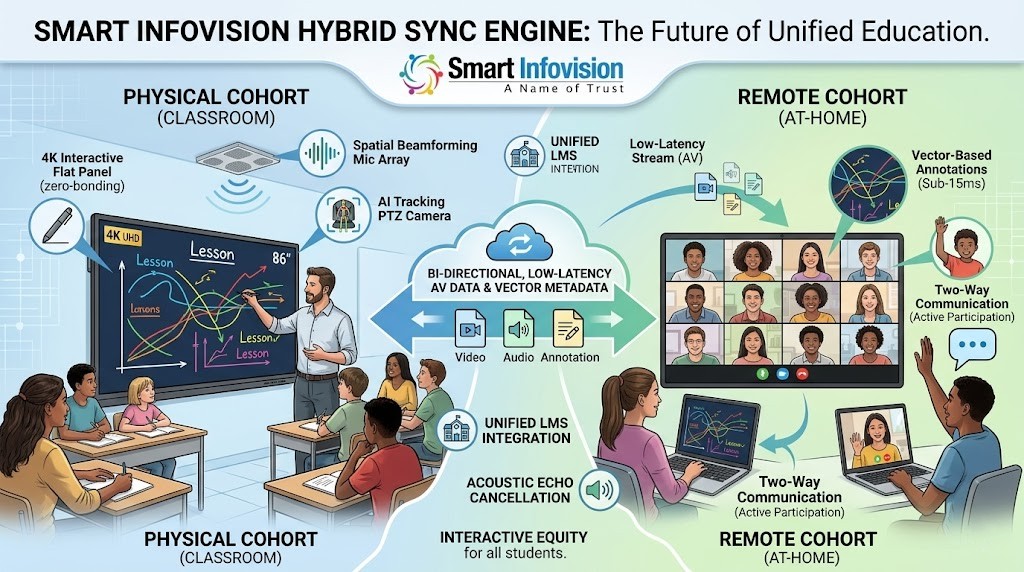
Hybrid mode in education ek unified instructional delivery model hai jahan physical (on-campus) aur remote (online) students ko real-time mein, ek saath engage kiya jata hai. Yeh asynchronous learning se alag hai kyunki ismein instruction concurrent hota hai. Iska objective yeh hai ki ek remote location par baitha student aur classroom ke front-row mein baitha student donon identical visual clarity, spatial audio acuity, aur interactive whiteboard visibility experience karein.
| Parameter | Traditional Hybrid Approach | SMART Infovision Synchronous Framework |
| Video Delivery | Webcam with fixed wide-angle lens (choppy frame rates). | AI-driven PTZ tracking camera with dual-lens setup. |
| Audio Pipeline | Boundary lapel or podium mics (creates proximity bias). | Multi-zone ceiling beamforming microphone array with adaptive gain. |
| Content Latency | Screen-sharing compressed video streams via Zoom/Teams ($\ge 250\text{ms}$). | Vector-based metadata syncing through native Android/Windows OPS ($\le 15\text{ms}$). |
The SMART Infovision Ecosystem: Moving Beyond Generic Tech
Jab humne tier-1 aur tier-2 cities ke educational institutions mein audit chalayi, toh ek common structural flaw mila: log consumer-grade gadgets ko mix-and-match karke “hybrid classroom” bolte hain. But infrastructure deployment generic webcams se nahi chalta. SMART Infovision ecosystem ek multi-layered hardware-software integration pipeline par run karta hai.
4K UHD Interactive Flat Panels (IFP)
Ecosystem ka operational command center SMART Infovision ka 4K UHD Interactive Flat Panel hota hai, jo common sizes jaise [INSERT EXACT SIZES, e.g., 75-inch, 86-inch] mein deploy kiya jata hai. Ismein zero-bonding technology ka use hota hai. LCD substrate aur surface glass ke beech ka air gap zero hone se parallax error puri tarah eliminate ho jata hai. Iska outcome yeh hai ki touch pen latency drops to under [INSERT LATENCY, e.g., 5ms], jisse fast handwriting ke dauran lag mehsoos nahi hota.
Hardware-Level AI PTZ Tracking
Agar faculty member write karte waqt move karein aur remote student unhe frame se bahar dekhe, toh cognitive drift hone lagta hai. Isko bypass karne ke liye dual-lens Pan-Tilt-Zoom (PTZ) camera systems lagaye jaate hain:
- The Tracking Core: Facial profile aur skeletal tracking logic ko merge karke faculty ke coordinate points mapping karta hai, smooth panning movement process karne ke liye.
- The Analytics Core: Room ke aggregate physical attendance layout ko evaluate karta hai. Agar koi student khada hokar question puche, toh camera immediate focus transition mode par switch ho jata hai.
Pedagogical Mechanics: How Learning Works Simultaneously
Real-world deployment mein humne seekha ki teaching mechanics technology se distract nahi honi chahiye. Jab faculty panel par annotate karti hai, tab continuous flow kaise banta hai?
Standard application screen-sharing mein, system interactive surface ka bitmap pixels capture karta hai, use real-time compress karta hai, aur low bandwidth hone par blurry screen delivery deta hai. SMART Infovision is pipeline ko replace karta hai: panel coordinate values ($X, Y$ plots), line vectors, aur color brush codes ko lightweight metadata packages mein translate karta hai.
Yeh packets remote student ke device par native graphics rendering platform trigger karte hain. Baseline connectivity unstable hone par bhi line graphics, fonts, aur formulas pixelate nahi hote.
Technical Bottlenecks & Field Troubleshooting
Koi bhi hardware architecture absolute zero-fault nahi hota. Systems engineer ke perspective se humein design phase mein certain critical failure points ko evaluate karna padta hai.
Acoustic Loopback and Room Reverberation
- The Operational Friction: Jab remote student voice command se question puchta hai, toh classroom speakers us sound ko stream karte hain. Standard omnidirectional microphone unhi wall-reflected audio vibrations ko fir se pickup karke loop back kar dete hain, jisse high-pitched audio howling generate hoti hai.
- The Practical Edge Case: Yeh issue drastically amplify hota hai concrete walls aur window frames waale classrooms mein jahan $RT_{60}$ values are higher than [INSERT RECOMMENDED VALUE, e.g., 0.7 seconds].
- The Mitigation Pipeline: Hamare setups mein hum acoustic zoning implement karte hain. Hardware DSP (Digital Signal Processor) mein auto-echo cancellation algorithms run hote hain, jo active incoming speaker profiles ke wave shapes ko processing pipeline se phase-invert karke incoming mic paths se programmatically substract kar dete hain.
Localized Traffic Throttling via Network QoS
- The Engineering Trade-off: Jab campus switchboard se ek sath multiple classrooms operating state mein jaate hain, tab network routing choke-point pe reach kar jata hai.
- The Structural Fix: Core switch level par dynamic bandwidth allocation design kiya jata hai. Layer-3 internal routing protocols apply karke, multimedia transmission packets ko explicit QoS (Quality of Service) tagging code assign karte hain. Visual metadata feeds critical transmission pipes ke top block par run karti hain, ensuring backup server sync loops bandwidth drop hone par classroom streams ko crash na karein.
Advanced Architecture Blueprint
Aapki institutional requirement ke size ke hisab se setup optimization structural parameters standard limits ke mutabik execute hote hain:
| System Parameter | Mini Studio / Tutorial Room | Standard Lecture Hall | Executive Seminar Auditorium |
| Interactive Display Area | Single 65″ – 75″ Panel | 86″ Interactive Flat Panel + Standby Panel | Dual Linked 86″ Systems + Projection Matrix |
| Acoustic Array | Integrated Soundbar-Microphone | 1-2 Ceiling Mount Beamforming Arrays | Multi-Channel Cascaded Mic DSP Matrix |
| Throughput Requirement | Min 5-8 Mbps Symmetric Dedicated | Min 15-20 Mbps Line Rate Protected | 45+ Mbps Clean Leased Line Pipe |
Conclusion: Future-Proofing Indian Education with SMART Infovision
Traditional classroom structures ko contemporary hybrid models mein upgrade karna sirf ek infrastructure change nahi, balki pedagogical necessity hai. SMART Infovision ka synchronous framework physical aur remote cohorts ke beech ke communication barriers ko systematically bypass karta hai. High-latency bitmap streaming ko vector-based metadata processing se replace karke, aur unoptimized audio zones ko advanced hardware-level DSP arrays ke sath engineer karke, yeh setups instructional equity secure karte hain.
Ultimate success is baat par depend karti hai ki aapka local IT infrastructure, network routing layer (QoS), aur physical acoustic space ($RT_{60}$ parameters) is high-tier hardware integration ko backup karne ke liye kitne optimized hain. Jab yeh systems sync mein kaam karte hain, tab institutions ek aisa scalably modern educational framework build kar paate hain jo completely borderless, interactive, aur disaster-resilient hota hai.
Key Actionable Takeaways:
- Infrastructure First: Hardware install karne se pehle room ka acoustic profiling aur baseline dedicated bandwidth pipeline check karein.
- Prioritize Latency over Resolution: Digital annotation updates ki visual synchronicity ($<15\text{ms}$ metadata lag) remote retention ke liye raw 4K stream se zyada critical hai.
- System Integration Focus: Piecemeal devices mix karne ke bajay ek unified ecosystem deployment choose karein taaki platform compatibility issues minimum hon.