
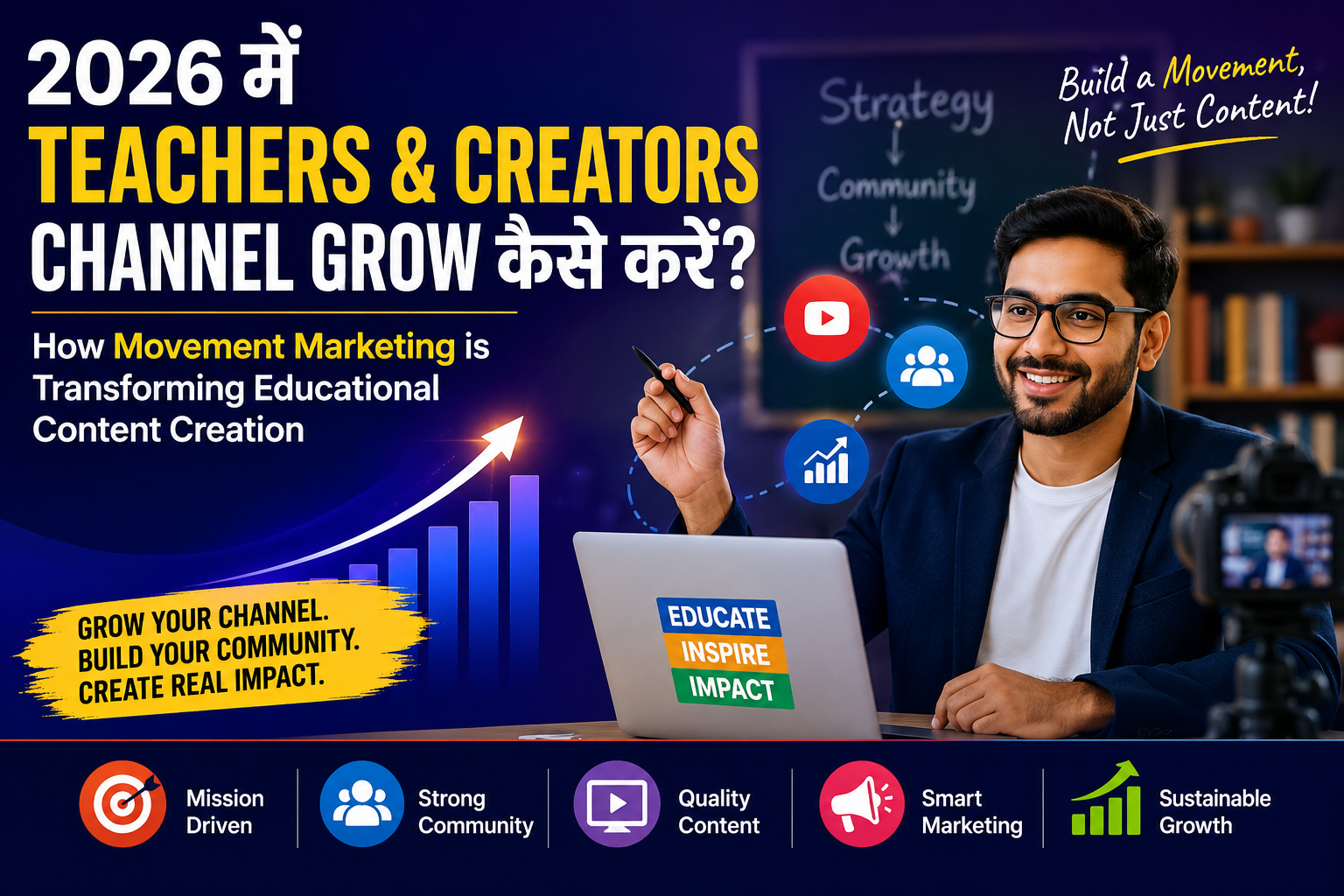
The New Era of Content Creation Has Arrived
The landscape of digital content creation is changing at an unprecedented pace. What worked for creators and educators just a few years ago is rapidly becoming ineffective in today’s highly competitive environment. As millions of videos are uploaded every day across YouTube, Instagram, Facebook, and emerging educational platforms, teachers and creators face a common challenge: how to stand out and grow sustainably.
For years, content creators focused primarily on views, subscribers, and watch time. While these metrics still matter, they are no longer enough to ensure long-term success. In 2026, the most successful educational channels are not necessarily those with the highest upload frequency or the biggest advertising budgets. Instead, they are the channels that have successfully built communities around a shared purpose.
This shift has given rise to a powerful strategy known as Movement Marketing, a concept that is redefining how teachers, trainers, coaches, and educational creators connect with their audiences.
Why Traditional Growth Strategies Are Losing Effectiveness
Many educators continue to rely on traditional content marketing techniques, believing that publishing more videos will automatically result in greater visibility. However, audience behavior has evolved significantly.
Today’s viewers are overwhelmed by information. They no longer subscribe simply because a channel provides useful content. Instead, they follow creators who represent values, solve meaningful problems, and create a sense of belonging.
The average learner now seeks more than lessons. They seek guidance, mentorship, inspiration, and community. This evolution has fundamentally changed the rules of digital growth.
As algorithms become increasingly sophisticated, platforms are rewarding creators who generate genuine engagement rather than passive consumption. Comments, discussions, shares, community interactions, and audience retention have become stronger indicators of content quality than raw view counts.
Consequently, channels built solely around content production are finding it increasingly difficult to maintain growth, while channels built around community and purpose are experiencing remarkable success.
Understanding the Rise of Movement Marketing
Movement Marketing is not about selling products or promoting services. It is about creating a shared mission that people want to support.
Instead of asking viewers to watch a video, Movement Marketing invites them to become part of something larger than themselves.
For educational creators, this approach can take many forms. A teacher may focus on transforming traditional classrooms through digital technology. An educational consultant may advocate for affordable learning opportunities. A creator may champion skill-based education or help students prepare for future careers.
The common factor is purpose.
People naturally connect with missions that align with their aspirations. When audiences believe in a creator’s mission, they become emotionally invested in the journey. They begin sharing content, recommending the channel to others, and actively participating in discussions.
At that point, growth becomes organic rather than algorithm-dependent.
The Creator Economy in 2026: A Massive Opportunity for Educators
The global creator economy continues to expand, creating unprecedented opportunities for educators and subject matter experts. As digital learning becomes increasingly mainstream, audiences are actively searching for trustworthy sources of information.
This trend is particularly evident in sectors such as educational technology, online teaching, hybrid classroom solutions, artificial intelligence in education, professional development, and digital transformation.
Teachers who once relied exclusively on physical classrooms are now becoming influential content creators with audiences extending far beyond geographical boundaries.
Educational creators are no longer competing solely with other teachers. They are competing with media companies, online learning platforms, influencers, and AI-powered content ecosystems. To thrive in this environment, creators must develop strategies that build authority, trust, and community simultaneously.
This is where Movement Marketing provides a significant competitive advantage.
Building a Mission-Driven Educational Brand
Every successful movement begins with a clearly defined purpose. Before focusing on content calendars, video production, or subscriber targets, creators must answer a fundamental question:
“What change do I want to create in the lives of my audience?”
This question serves as the foundation of a movement-driven brand.
For example, an educator specializing in digital boards may position their channel around transforming traditional teaching methods through interactive technology. A career mentor may focus on preparing students for future job markets. A creator covering educational innovation may dedicate their platform to helping institutions adopt modern learning practices.
When a mission is clearly communicated, audiences quickly understand what the creator stands for. This clarity attracts like-minded individuals who are more likely to engage deeply with the content.
Over time, these individuals evolve from viewers into advocates.
The Power of Storytelling in Audience Growth
One of the most overlooked growth strategies among educational creators is storytelling.
Facts educate, but stories inspire action.
The human brain is naturally wired to remember narratives. While viewers may forget statistics and technical explanations, they remember personal journeys, challenges, transformations, and success stories.
Educational creators who effectively incorporate storytelling into their content often experience stronger audience retention and deeper emotional connections.
A story about a teacher successfully implementing digital learning tools in a rural classroom is far more compelling than simply listing product features. Likewise, sharing a student’s transformation through innovative learning methods creates emotional resonance that drives engagement.
Storytelling transforms information into experience, making content more memorable and shareable.
Why Community Has Become More Valuable Than Subscribers
In previous years, subscriber counts were considered the ultimate measure of success. However, many channels with large subscriber bases struggle to generate meaningful engagement.
The reason is simple: subscribers are not necessarily community members.
A community actively participates. Community members discuss ideas, provide feedback, support one another, and contribute to the overall mission.
This distinction is becoming increasingly important as platforms prioritize meaningful interactions.
Creators who build communities through discussion forums, WhatsApp groups, Telegram channels, newsletters, and live sessions often achieve stronger long-term growth than those focused exclusively on subscriber acquisition.
Communities create loyalty, and loyalty creates sustainability.
Short-Form Content and the New Discovery Engine
The rise of short-form video continues to reshape content discovery in 2026. Platforms are investing heavily in recommendation systems designed to surface engaging content to new audiences.
For teachers and creators, short-form content represents an opportunity rather than a threat.
Well-crafted educational shorts can introduce expertise, demonstrate quick tips, highlight classroom innovations, and attract viewers to longer-form content.
Rather than replacing traditional videos, short-form content serves as a discovery engine that expands audience reach.
Creators who integrate short-form and long-form content into a unified strategy are positioning themselves for greater visibility and stronger audience growth.
Trust: The Most Powerful Growth Factor
Trust remains the foundation of every successful creator brand.
In an era dominated by AI-generated content and information overload, audiences are increasingly selective about whom they choose to follow. Educational creators who consistently provide accurate information, transparent communication, and authentic insights build credibility over time.
Trust cannot be purchased through advertising.
It is earned through consistency, expertise, and genuine commitment to audience success.
This is why many educational creators with relatively small audiences generate greater influence than larger entertainment-focused channels. Their audiences view them as reliable sources of knowledge and guidance.
As trust grows, recommendations increase, engagement improves, and authority strengthens.
The Future Belongs to Movement Builders
The most significant lesson for teachers and creators entering 2026 is that content alone is no longer enough.
The future belongs to movement builders.
Creators who inspire action, unite communities, and champion meaningful missions will outperform those focused solely on publishing videos. Movement Marketing enables educators to move beyond algorithmic dependency and establish lasting influence within their industries.
As educational technology continues to evolve and learning becomes increasingly digital, creators who build mission-driven communities will shape the future of education itself.
The question is no longer whether you can create content.
The question is whether you can create a movement worth joining.
For educators, trainers, coaches, and creators seeking sustainable growth, the answer may define their success for years to come.
Frequently Asked Questions
What is Movement Marketing for educational creators?
Movement Marketing is a strategy that focuses on building a community around a shared mission rather than simply producing content. It helps creators establish deeper audience relationships and long-term engagement.
Why is community more important than subscribers in 2026?
Subscribers may watch content occasionally, but community members actively participate, share ideas, recommend content, and contribute to overall growth.
Can small educational channels use Movement Marketing?
Yes. In fact, smaller channels often build stronger communities because they can interact more personally with their audience.
How does storytelling help teachers grow online?
Storytelling creates emotional connections, improves audience retention, and makes educational content more memorable and impactful.
Is short-form content necessary for growth?
Yes. Short-form videos play a critical role in content discovery and help creators reach new audiences quickly.
What is the biggest mistake educational creators make?
Many creators focus solely on content production while neglecting community building, audience engagement, and long-term brand positioning.
Conclusion
As the creator economy enters a new phase of maturity, educators and content creators must adapt to changing audience expectations. The channels experiencing the fastest growth are not merely producing educational videos; they are building communities united by a common purpose.
Movement Marketing offers a powerful framework for achieving this transformation. By focusing on mission, storytelling, trust, and community, teachers and creators can create lasting impact while achieving sustainable channel growth.
In 2026 and beyond, success will belong to those who inspire participation rather than passive consumption. The creators who build movements today will become the educational leaders of tomorrow.

